

Blog and Insights .
Choosing the Right NIBP Cuff: A Complete Guide to Neonatal, Pediatric, Adult & Thigh Sizes for Accurate Blood Pressure Measurement
Author:
Lub Dub Admin
Introduction
Measuring blood pressure accurately is essential for diagnosing patients, planning their treatment, and monitoring their progress in any clinical setting. However, one important factor that often gets overlooked is the size of the NIBP cuff. Whether you are checking a premature baby in the NICU or managing high blood pressure in an adult ICU patient, choosing the right
cuff size directly affects patient outcomes.
This guide provides all the information healthcare professionals, biomedical engineers, and medical procurement teams need about selecting NIBP cuffs. It covers everything from understanding size charts to deciding between reusable and disposable options.
Why Correct NIBP Cuff Size Matters?
The non-invasive blood pressure (NIBP) cuff occludes arterial blood flow and senses the return of pulsatile flow as pressure is released. The cuff bladder must be a certain proportion of the patient’s arm circumference for this mechanism to work correctly. Usually it is 80% of the arm circumference in length and 40% of the arm circumference width.
When a clinician uses a cuff that is the correct size:
– Systolic and diastolic readings reflect true arterial pressure
– Treatment decisions are based on reliable data
– Patient safety is maintained, particularly in critical care environments
– Repeat measurements show consistency, enabling trend monitoring
Hospitals, clinics and diagnostic centers need to have a full range of blood pressure cuff sizes to
meet the needs of their patient populations – from the tiniest neonates to adults who require
thigh cuffs.
The Impact of Wrong Cuff Size on Blood Pressure Readings
The use of an NIBP cuff that is the wrong size can result in systematic errors in measurement and can result in misdiagnosis and inappropriate treatment:
Cuff Too Small
● Overestimates blood pressure (false hypertension)
● May lead to unnecessary antihypertensive medication
● Common in obese patients when standard adult cuffs are used
Cuff Too Large
● Underestimates blood pressure (masked hypertension)
● May delay treatment for genuine hypertension
● Common in pediatric patients when adult cuffs are used
Research has shown that using a cuff that is too small can raise systolic readings from 10 to 50 mmHg and that a cuff that is too large may lower the reading by 10 to 30 mmHg. Such errors can have grave consequences for the management of critically ill and surgical patients.
Factors Influencing Cuff Selection
Arm Circumference
The most important consideration when choosing a cuff size is the patient’s mid-upper arm circumference, measured at the midpoint between the shoulder and the elbow. Each cuff size corresponds to a range of circumferences.
Body Size and Build
Patient body habitus (height, weight and fat distribution) influences arm dimensions. Muscular patients may require larger cuffs even though they are of normal body weight.
Obesity Considerations
Blood pressure measurement in obese patients presents specific challenges. Conical arm shapes prevalent in obesity may impede proper cuff fit. In such cases:
● Large adult cuffs (32–42 cm) accommodate many obese patients
● Thigh BP cuffs (44–54 cm) may be necessary for severely obese patients when arm measurement is impractical
● Forearm measurement with appropriate cuffs offers an alternative site Age and Development
In pediatric and neonatal patients specialized cuffs are needed due to their anatomy. Adult cuffs
on children virtually guarantee inaccurate readings.
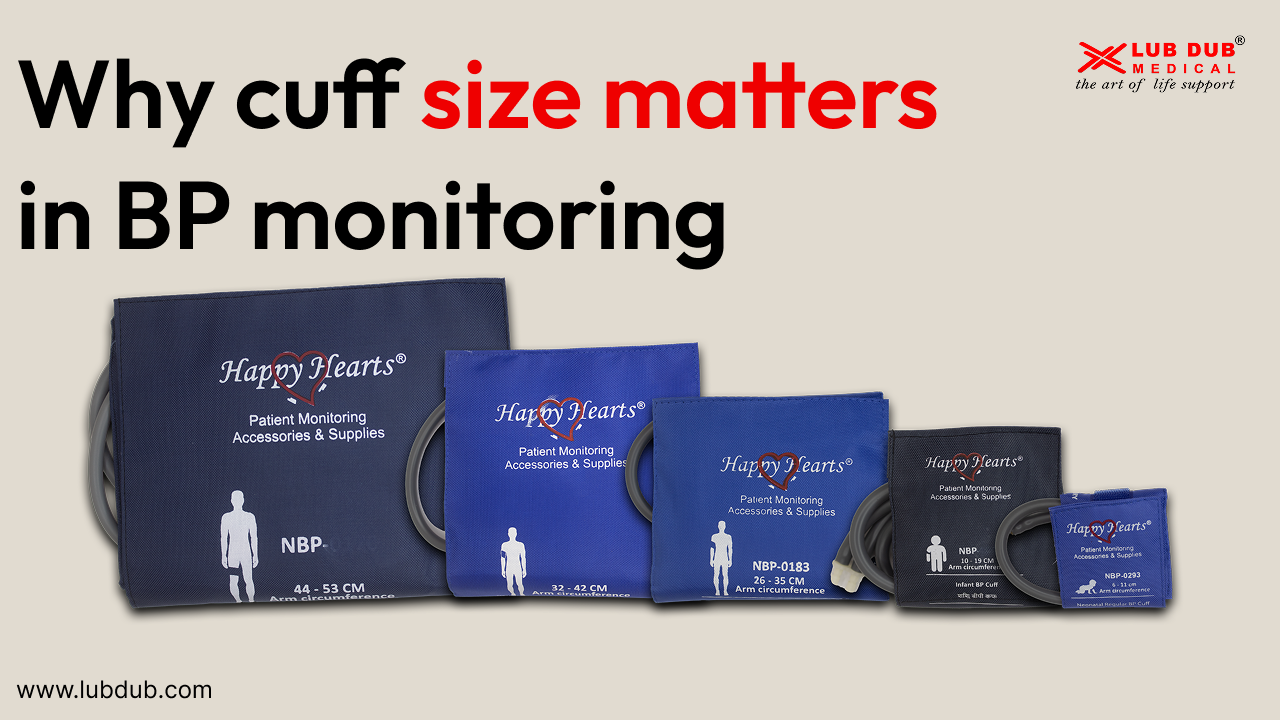
NIBP Cuff Size Chart: Reusable Cuffs
Lub Dub Medical Technology Pvt. Ltd. manufactures a complete range of reusable BP cuffs designed for durability and repeated use across patient populations:
| Cuff Type | Arm Circumference (cm) | Typical Patient |
|---|---|---|
| Neonatal | 6–11 | Premature and newborn infants |
| Infant (Small) | 9–14 | Infants 1–12 months |
| Infant (Large) | 10–19 | Larger infants and small toddlers |
| Pediatric | 14–21 | Children ages 2–8 |
| Small Adult | 17–25 | Adolescents and small-framed adults |
| Adult | 26–35 | Average adult patients |
| Large Adult | 32–42 | Larger adults and obese patients |
| Thigh | 44–54 | Severely obese patients or thigh measurement |
Reusable cuffs feature durable outer materials, cleanable surfaces, and replaceable bladders, making them cost-effective for high-volume clinical environments.
Disposable BP Cuff Size Chart
For infection-sensitive environments and single-patient use, disposable BP cuffs eliminate cross-contamination risks:
| Size Designation | Arm Circumference (cm) | Application |
|---|---|---|
| Size 1 | 3–6 | Micro-premature neonates |
| Size 2 | 4–8 | Premature neonates |
| Size 3 | 6–11 | Term neonates |
| Size 4 | 7–13 | Large neonates to small infants |
| Size 5 | 8–15 | Infants |
Disposable cuffs are essential for ICU monitoring accessories where infection control protocols mandate single-use items, particularly in neonatal and immunocompromised patient populations.
Reusable vs. Disposable Cuffs: Making the Right Choice
Reusable BP Cuffs
Advantages:
● Lower long-term cost per use
● Environmentally sustainable
● Available in full size range including thigh cuffs
● Durable construction withstands thousands of cycles
Best for: General wards, outpatient clinics, diagnostic centers, and settings with robust cleaning protocols
Disposable BP Cuffs
Advantages:
● Eliminates cross-contamination risk
● No cleaning or maintenance required
● Ideal for isolation patients
● Reduces hospital-acquired infection rates
Best for: ICUs, NICUs, isolation rooms, immunocompromised patients, and high-turnover emergency departments
Many facilities are employing a hybrid approach with reusable cuffs for the general population
and disposable cuffs for high-risk patients.
ICU Monitoring and Infection Control
Blood pressure is continuously monitored in the intensive care unit and patients are frequently immunocompromised or suffering from transmissible pathogens. Proper cuff selection and management directly impacts infection control:
● Dedicated cuffs for isolation patients prevent pathogen transmission
● Single-use disposable cuffs eliminate disinfection failures
● Proper sizing reduces skin breakdown from repeated measurements with ill-fitting cuffs
● Compatible patient monitor accessories ensure seamless integration with existing equipment
Biomedical engineers are instrumental in ensuring cuff compatibility with monitoring systems
and determining replacement schedules to ensure measurement accuracy.
Pediatric BP Cuff Considerations
Children are not little adults – their physiology, anatomy and clinical needs are fundamentally different. Accurate pediatric blood pressure measurement requires:
● Age-appropriate cuff sizes from neonatal through adolescent ranges
● Proper technique including adequate rest before measurement
● Reference to pediatric blood pressure percentiles rather than adult normal ranges
● Consideration of anxiety which can elevate readings in children
The pediatric BP cuff range (14–21 cm) fills the gap between infant and adult sizes, but many children need infant or small adult cuffs according to their individual arm circumference.
Thigh BP Cuff Applications
The thigh BP cuff (44–54 cm) serves specialized purposes:
● Severely obese patients whose arm circumference exceeds large adult cuff capacity
● Patients with arm injuries, burns, or vascular access that preclude arm measurement
● Ankle-brachial index calculation for peripheral arterial disease assessment
● Comparative measurements between upper and lower extremities
Thigh measurement requires appropriate technique and understanding that values will differ from arm readings due to vascular anatomy.
Digital BP Cuff Specifications
Modern digital blood pressure monitoring has become standard in both clinical and home settings. Lub Dub Medical Technology provides bearing cuffs with a wide measurement range of 22–42 cm, accommodating most adult patients with a single cuff size.
Digital BP cuffs feature:
● Integrated sensors for automatic inflation and deflation
● Compatibility with electronic monitors and patient management systems
● Memory function for trend tracking in home monitoring devices
● Validated accuracy meeting international standards
Manual BP Apparatus Components
Traditional sphygmomanometers remain essential for clinical training, validation of automated readings, and settings without electronic equipment. A complete manual BP apparatus includes:
● Cloth Cuff – The outer fabric covering that wraps around the patient’s arm, providing structure and containing the bladder. Available in multiple sizes corresponding to the circumference ranges listed above.
● Bladder – The inflatable rubber component that applies pressure to occlude the artery. Bladder dimensions must match the cuff size for accurate measurement.
● Bulb – The hand-operated inflation device that allows controlled pressurization of the bladder.
● Valve – The release mechanism that enables gradual, controlled deflation during auscultation. Precise valve function is essential for accurate readings.
Customized NIBP Cuffs: Meeting Unique Patient Requirements
Most patients are covered by the standard cuff sizes, but special cases require individual solutions. Lub Dub Medical Technology Pvt. Ltd. is a manufacturer of customized blood pressure cuffs, designed according to unique patient requirements, clinical protocols and equipment compatibility.
A best example of such capability was the offering of customized NIBP cuffs tailored to the physiological needs of the former Tamil Nadu Chief Minister J. Jayalalithaa during her medical care – a clear demonstration of Lub Dub’s ability to provide precision-engineered solutions to complex clinical scenarios.
Custom cuff manufacturing addresses:
● Non-standard arm configurations
● Bariatric patient requirements
● Pediatric specialty applications
● Equipment-specific connector compatibility
● Institutional branding and identification
Conclusion
Choosing the correct Needing Idiopathic Blood Pressure (NIBP) cuff is critical to the accuracy of diagnostic testing and ultimately, your patient. Whether blood pressure cuffs needed for premature neonates or thigh cuffs for adults are selected based on size, these measurements will provide an accurate reflection of the true physiologic condition of the patient.
Healthcare organisations need to maintain a thorough inventory of blood pressure cuff sizes, write specific protocols for use in determining cuffs to use, and train clinicians on proper measurement techniques. Whether the institution places importance on reusing BP cuffs for sustainability and cost-effectiveness or using disposable BP cuffs for the maximum degree of infection control, quality and proper cuff sizing must always be regarded.
FAQ
Find Out Answers Here
Measure the patient’s mid-upper arm circumference using a tape measure. Select the cuff whose size range includes this measurement. If the circumference falls at the boundary between two sizes, choose the larger cuff to avoid overestimation.
No. Using an oversized cuff will underestimate blood pressure, potentially masking hypertension. Always use age- and size-appropriate pediatric BP cuffs.
Inspect cuffs regularly for bladder integrity, connector condition, and fabric wear. Most manufacturers recommend replacement after 2–3 years of regular use or sooner if damage is detected. Bladders that fail to hold pressure or connectors with air leaks require immediate replacement.
Yes, when properly sized and applied. Disposable cuffs undergo the same quality and accuracy standards as reusable options.
For patients outside standard ranges, consider alternate measurement sites (forearm, thigh), invasive arterial monitoring, or contact a manufacturer like Lub Dub Medical Technology for customized cuff solutions.
Follow manufacturer guidelines. Most cloth cuffs can be wiped with hospital-grade disinfectant. Avoid saturating the bladder or submerging cuffs in liquid. Some cuffs feature removable, washable covers.
Yes. The cuff bladder should be centered over the brachial artery, and the cuff should be positioned at heart level. Clothing under the cuff, loose application, or placement over joints compromises accuracy.